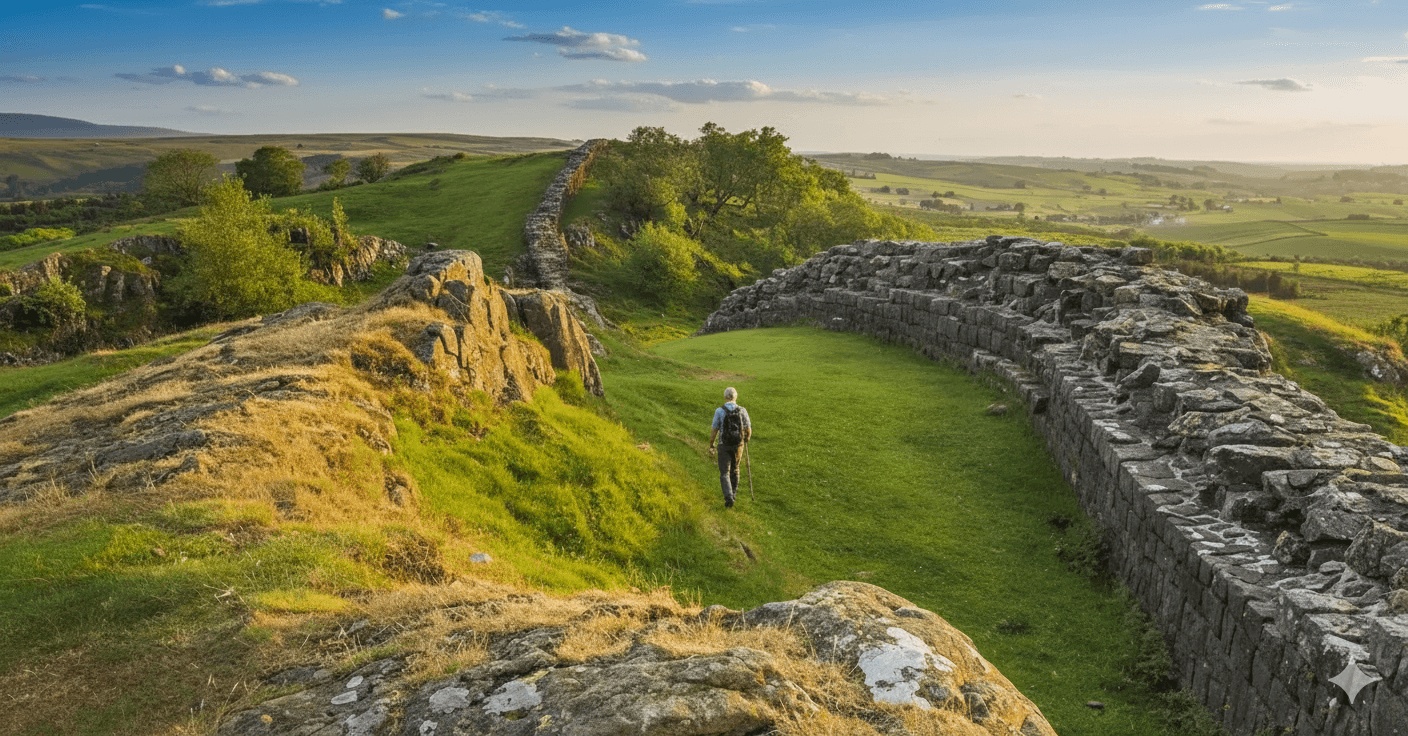
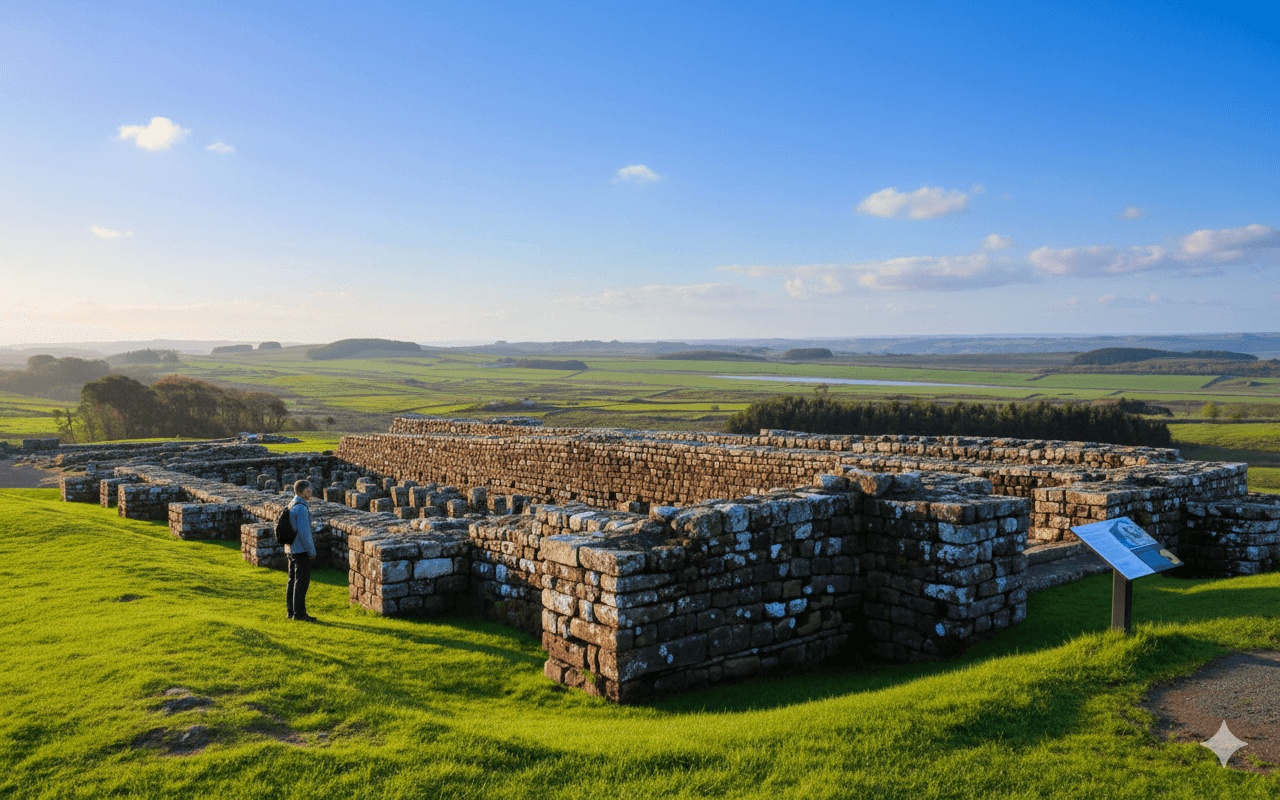
Day 3 of Hadrian's Wall Path is when the walk transforms from pleasant countryside rambling to genuinely spectacular long-distance walking. This section from Chollerford to Steel Rigg takes you through some of the most historically significant sites on the wall, climbing from the North Tyne Valley onto the high ground where you get your first taste of the dramatic landscape ahead.
At around 13 miles, Day 3 is slightly shorter than the previous two days, but the terrain is more demanding and the attractions more compelling. Plan for a day of exploration as well as walking - you won't want to rush past Chesters Fort or the temple at Brocolitia.
Day 3 Overview: The Numbers
Here's what Day 3 involves:
- Distance: 13 miles (21 km)
- Terrain: Field paths, moorland, increasing roughness
- Elevation gain: Significant - climbing from valley floor to crags
- Walking time: 6-7 hours including site visits
- Difficulty: Moderate to challenging - terrain becomes rougher
- Facilities: Limited - carry food and water
The character of the walk changes dramatically on Day 3. You're leaving the relatively gentle farmland of the eastern sections and entering the wild country where Hadrian's Wall claims its most dramatic terrain. By day's end, you'll be on the edge of the famous central crags.
Starting from Chollerford: Chesters Roman Fort
Your first stop on Day 3 is unmissable: Chesters Roman Fort (Cilurnum). This was a cavalry fort, home to 500 horsemen who patrolled this section of the frontier. The site is exceptionally well-preserved, with highlights including:
- The bathhouse: Perhaps the best-preserved Roman military bathhouse in Britain
- The barracks: Clear layout showing where soldiers lived
- The commander's house: With underfloor heating still visible
- The museum: Clayton Collection of Roman inscriptions and artifacts
- The bridge abutment: Where the wall crossed the North Tyne
Allow at least an hour for Chesters, more if you're interested in Roman history. The site opens at 10am (check current times), so an early start from Chollerford gets you there as it opens. If you visited yesterday evening, you can pass straight through.
The fort is managed by English Heritage. If you're walking the entire wall, an English Heritage membership pays for itself in site entry fees and supports the conservation of these remarkable places.
Chesters to Brocolitia (4 miles)
Leaving Chesters, the path follows the wall line through increasingly open country. You're climbing gradually out of the North Tyne Valley, with views improving as you gain height. The wall remains become more frequent, with several good sections of curtain wall visible.
At Limestone Corner, you reach an important geological boundary. Here the wall's builders had to adapt their construction to cross an outcrop of hard Whin Sill rock - the same volcanic intrusion that creates the dramatic crags of the central section. You're getting a preview of what's to come.
Brocolitia (Carrawburgh) was another significant fort, though less is visible today than at Chesters. However, the site has a unique attraction: the Mithraeum, a temple to the mysterious god Mithras. This atmospheric underground shrine was discovered in 1949 and gives insight into the diverse religious practices of Roman soldiers.
The Mithraeum is a short detour from the main path but absolutely worth visiting. The temple's reconstruction helps you understand how these spaces would have looked, lit by torches as soldiers gathered for their secret rites.
Brocolitia to Housesteads Visitor Centre (5 miles)
This section is where Day 3 really delivers. The path climbs steadily through rough moorland, with the wall becoming increasingly prominent. On your left, the ground drops away to the north - you're walking along the top of increasingly dramatic escarpments.
Key features of this section:
- Milecastle 35: Well-preserved milecastle on the ridge
- Sewingshields Crags: First real taste of the dramatic central terrain
- King's Wicket: Historic gateway through the wall
- Housesteads approach: The path descends to the visitor centre
As you approach Housesteads, you'll see the famous crags stretching westward - the terrain you'll be crossing on Day 4. This is the view that defines Hadrian's Wall in most people's imagination.
The Housesteads visitor centre has toilets, a shop, and refreshments. Even if you're not visiting the fort today (you'll pass it on Day 4), it's a good place for a break before the final push to Steel Rigg.
Housesteads to Steel Rigg (4 miles)
The final section of Day 3 takes you through some of the finest walking on Hadrian's Wall Path. You're now on the central crags section, with the wall perched dramatically on cliffs above Crag Lough.
Highlights of this afternoon stretch:
- Housesteads Roman Fort: The most complete Roman fort in Britain (optional visit)
- Cuddy's Crags: Named after St Cuthbert, with spectacular views
- Crag Lough: A beautiful natural lake below the crags
- Milecastle 39: The famous Sycamore Gap location
- Steel Rigg car park: Day's end with views across the central section
If you have energy and time, Housesteads Roman Fort is unmissable. The latrines, granaries, and commanding officer's house are exceptionally preserved. However, many walkers save Housesteads for Day 4, approaching it fresh in the morning.
Steel Rigg and Once Brewed
Steel Rigg itself is just a car park with stunning views. Accommodation is at nearby Once Brewed and Twice Brewed, twin villages with an unusual naming story (supposedly, the local beer was brewed twice to make it stronger for wall workers).
Accommodation options include:
- The Twice Brewed Inn: Historic inn with good food and accommodation
- Vallum Lodge: Purpose-built for walkers, comfortable and welcoming
- YHA Once Brewed: Youth hostel with the Sill visitor centre attached
- Various B&Bs: Several options in the area
The Sill National Landscape Discovery Centre at Once Brewed is worth visiting if you arrive early. It has excellent displays about the geology and history of the area, plus a rooftop viewing platform with panoramic views.
Navigation on Day 3
The path is well waymarked, but Day 3 requires more attention than previous days:
- Chesters to Brocolitia: Follow field paths carefully, especially in poor visibility
- Mithraeum detour: Signposted but easy to miss - watch for the turning
- Moorland section: Can be confusing in mist - stay with the wall line
- After Housesteads: The path is obvious along the crags
Carry an OS map (OL43) and consider downloading the GPX route to a smartphone app. In good visibility, you can't go wrong, but Northumberland mist can descend quickly.
Weather and Preparation
Day 3 is your first day on exposed high ground. Weather preparations are essential:
- Wind: The crags can be very windy - windproof jacket essential
- Rain: No shelter on the open sections - full waterproofs needed
- Cold: Temperatures drop significantly on the high ground
- Visibility: In mist, navigation requires care
Check the forecast carefully and be prepared to adjust your plans. In severe weather, the crags section can be postponed - most accommodation hosts can advise on local conditions.
What to Carry
Facilities are limited on Day 3. Carry:
- Water: At least 2 litres - limited refill options
- Lunch and snacks: Enough for a full day
- Full waterproofs: Even if the forecast is good
- Warm layers: Fleece, hat, gloves
- Camera: This is the day for spectacular photographs
- Site entry fee/membership: For Chesters and potentially Housesteads
Making the Most of Day 3
Day 3 is when many walkers fall in love with Hadrian's Wall Path. Tips for enjoying it fully:
- Start early: You want maximum daylight for the crags section
- Don't rush Chesters: It's one of the best Roman sites in Britain
- Visit the Mithraeum: The detour is worth every step
- Take breaks on the crags: Find a sheltered spot and absorb the views
- Photograph Crag Lough: The lake below the crags is stunning
- Celebrate at Steel Rigg: You've reached the heart of Hadrian's Wall country
Common Questions About Day 3
Should I visit Housesteads on Day 3 or Day 4? Most walkers visit on Day 4, approaching it fresh at the start of the day. However, if you're making good time on Day 3, an afternoon visit is perfectly feasible.
How hard is the terrain? Significantly harder than Days 1-2. The paths are rougher, with rocky sections and some steep climbs. Good boots are essential.
Is the Mithraeum worth the detour? Absolutely. It's a unique site that offers insight into Roman religious practices you won't find elsewhere on the wall.
What if the weather is bad? Consider reversing your day - visit indoor attractions (Chesters museum, The Sill) and save the crags section for better conditions if your schedule allows.
Looking Ahead: Day 4
Day 4 is the highlight of Hadrian's Wall Path for most walkers. You'll cross the most dramatic section of the entire route, passing Housesteads Fort, Sycamore Gap, and the spectacular central crags. It's challenging but unforgettable.
Rest well tonight - you've earned it after Day 3's climbing. Tomorrow delivers the wall at its absolute finest.
Plan Your Complete Hadrian's Wall Walk
Day 3 represents the transition into true Hadrian's Wall country. To experience the full 84 miles with properly planned accommodation and baggage transfer, explore our walking holiday itineraries.
Whether you prefer a challenging 4-day crossing or a more leisurely 8-day approach, we arrange everything: accommodation, baggage transfer, route information, and support throughout your journey.
Ready to walk from Wallsend to Bowness? Contact us to start planning your Hadrian's Wall adventure.