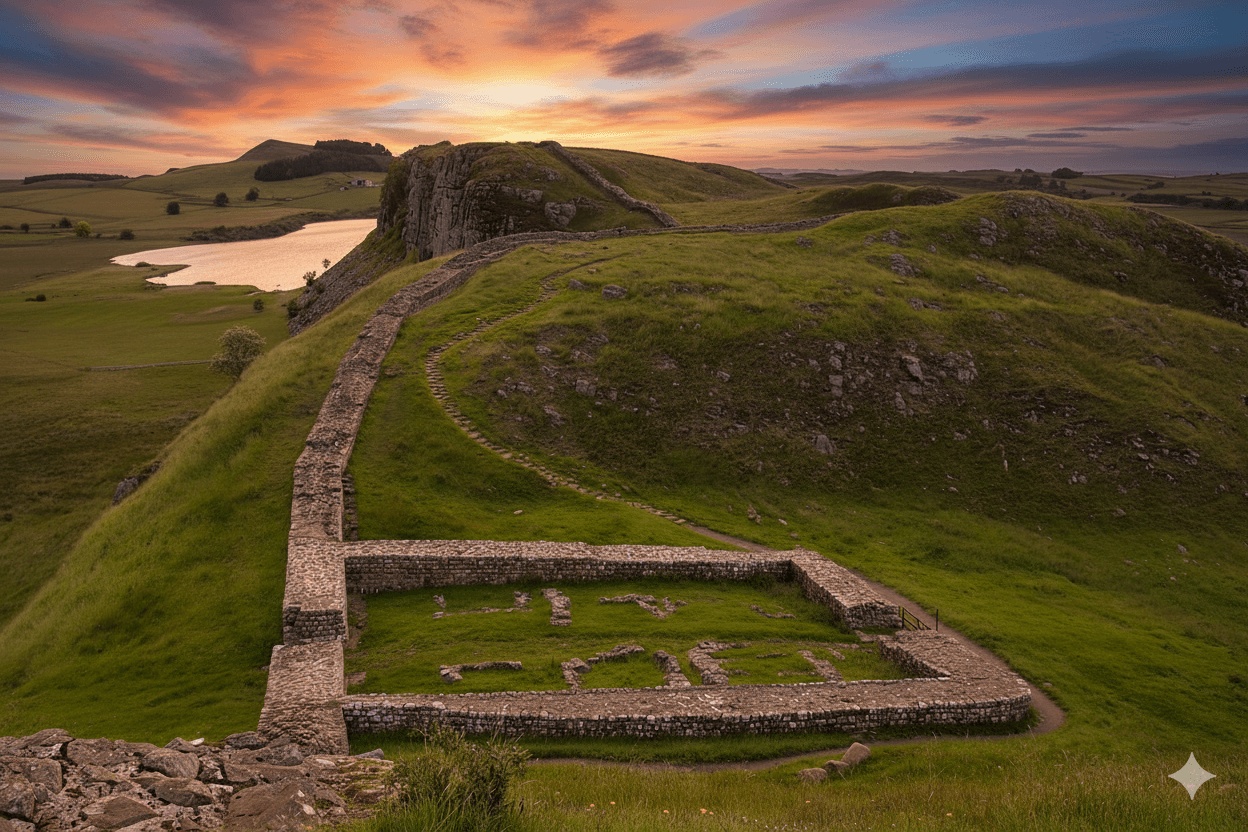
Vindolanda stands as one of the most remarkable archaeological sites in the Roman world, and for walkers on Hadrian's Wall Path, it presents an irresistible opportunity to step back nearly two thousand years into the daily lives of those who lived on Rome's northern frontier. While technically located just south of Hadrian's Wall itself, this extensive Roman fort and settlement has yielded more insights into Roman Britain than perhaps any other site, thanks largely to the extraordinary preservation of organic materials in its waterlogged soil and the ongoing excavations that continue to rewrite our understanding of frontier life.
For those walking the full Hadrian's Wall trail, the decision to detour to Vindolanda is one that every visitor must make. The site lies approximately one mile south of the main path, requiring a round trip of about 2 miles and 2-3 hours to do it justice. This guide will help you decide whether to include Vindolanda in your walking holiday and, if you do, how to make the most of your visit.
The Vindolanda Writing Tablets: Voices from the Past
Nothing quite prepares you for the emotional impact of reading words written by Roman soldiers, merchants, and their families nearly two millennia ago. The Vindolanda writing tablets, discovered from 1973 onwards, represent the oldest surviving handwritten documents in Britain and have fundamentally transformed our understanding of life on the Roman frontier. These thin wooden tablets, preserved in the oxygen-free conditions of the site's waterlogged deposits, contain letters, military reports, supply lists, and personal correspondence that bring the past to life with astonishing immediacy.
Perhaps the most famous tablet is the birthday invitation from Claudia Severa to Sulpicia Lepidina, asking her friend to join her birthday celebrations. This touching personal note, written around AD 100, represents one of the earliest known examples of Latin writing by a woman and speaks across the centuries with its warmth and humanity. Another tablet contains a soldier's complaint about not receiving proper clothing and requests warm socks, underpants, and sandals—a remarkably relatable concern for anyone who has walked the Wall in inclement weather.
Military tablets reveal the detailed administration of the frontier garrison. One famous document lists the strength report of the First Cohort of Tungrians, recording soldiers fit for duty, sick, wounded, and absent on various assignments. Others detail the enormous quantities of supplies required to maintain a frontier fort: grain, beer, wine, meat, salt, and the countless other necessities of Roman military life. These records provide invaluable evidence for understanding how the Roman army functioned on a daily basis.
The Archaeological Site: What You'll See
Vindolanda's extensive remains cover a vast area, with the visible ruins representing the final Roman occupation of the site in the fourth century AD. However, beneath these stones lie layer upon layer of earlier forts, each built on top of its predecessor and each sealed by the demolition debris that has preserved so much organic material. The site has been continuously excavated since 1970, and every summer new discoveries emerge from the ground.
The commanding officer's house (praetorium) provides one of the most complete examples of a Roman officer's residence in Britain. Its elaborate bath suite, underfloor heating system, and large reception rooms speak to the comfortable lifestyle enjoyed by the fort's commanders and their families. Nearby, the headquarters building (principia) shows the administrative heart of the garrison, complete with strongroom, assembly hall, and offices for the unit's clerks and administrators.
The civilian settlement (vicus) that grew up outside the fort walls offers fascinating insights into the communities that developed alongside Roman military installations. Here you can see the remains of shops, taverns, and houses where merchants, craftsmen, and the families of soldiers lived and worked. The presence of temples to various deities, including the oriental mystery god Mithras, shows the religious diversity of this frontier community.
The bath house, located outside the fort walls as was standard Roman practice due to fire risk, demonstrates the importance of bathing in Roman culture. Even on this distant frontier, soldiers expected the civilised comforts of hot and cold baths, exercise areas, and socialising spaces. The visible remains show the progression of rooms from the cold room through warm and hot rooms, with the furnace area that heated the water and underfloor spaces clearly visible.
The Vindolanda Museum
The on-site museum houses one of the finest collections of Roman artefacts in Europe, with many items on display that you won't see anywhere else. While the original writing tablets are held at the British Museum, the museum contains excellent reproductions alongside a wealth of other remarkable finds. Leather shoes in extraordinary states of preservation, wooden combs, textile fragments, and personal items paint an intimate picture of frontier life.
The museum's displays are thoughtfully organised to tell the story of life at Vindolanda across the centuries. Military equipment demonstrates the arms and armour of the garrison, while sections on food, drink, and daily life show how communities survived and thrived on the empire's edge. The collection of religious objects, including altars, figurines, and curse tablets, reveals the spiritual beliefs that guided people through life on the frontier.
Particularly moving are the displays of children's shoes and toys, reminding visitors that Vindolanda was not just a military installation but a community where families lived, children played, and ordinary people went about their daily lives. These intimate objects connect us to the humanity of the past in ways that grand architecture and military equipment cannot.
Visiting During Excavation Season
If your walking holiday falls between late March and September, you may have the opportunity to watch archaeologists at work, carefully revealing new discoveries from Vindolanda's rich deposits. The excavation team welcomes visitors and often stops to explain their work and recent finds. There's something uniquely thrilling about watching history emerge from the ground, knowing that you might be witnessing the discovery of objects unseen for nearly two thousand years.
The excavations regularly produce spectacular finds. Recent seasons have yielded a complete Roman cavalry sword, a bronze head of a god, and countless everyday objects that add to our understanding of the site. The waterlogged conditions that preserve organic materials mean that each year brings discoveries of leather, wood, and textile items that simply don't survive on drier sites.
For those with a particular interest in archaeology, Vindolanda offers opportunities to participate in excavations. The Vindolanda Trust runs programmes allowing members of the public to join the dig team under professional supervision. While this obviously requires more than a day's visit, it represents an extraordinary opportunity to contribute directly to archaeological research at a world-class site.
Practical Information for Walkers
Vindolanda lies approximately one mile south of the main Hadrian's Wall Path, most easily accessed from the stretch between Steel Rigg and Housesteads. The most common approach is from the Once Brewed area, where the path heading south to Vindolanda is well signposted. The walk from the main trail takes approximately 20-30 minutes each way, depending on your pace and the terrain conditions.
Entry to the site includes both the archaeological remains and the museum. Current prices can be found on the Vindolanda Trust website, and English Heritage members receive discounted entry. Allow a minimum of two hours for your visit, though those with a particular interest in Roman history could easily spend half a day exploring the site and museum.
The site has a café serving hot and cold refreshments, making it a good option for a lunch stop during your walk. Toilet facilities are available, and the museum shop stocks an excellent range of books and Roman-themed gifts. The site is partially accessible for visitors with mobility issues, though the archaeological remains involve uneven surfaces.
Is Vindolanda Worth the Detour?
For anyone with even a passing interest in Roman history, Vindolanda is absolutely worth the additional walking time. The site offers something that Housesteads and other Wall forts cannot: a direct connection to the everyday lives of the people who lived here. While Housesteads impresses with its dramatic setting and visible architecture, Vindolanda moves visitors through the intimacy of its discoveries—the birthday invitations, the requests for warm socks, the children's shoes that bring the past to vivid life.
For walkers on longer itineraries, the 8-day and 9-day packages offer the most comfortable time to include Vindolanda. These relaxed schedules provide shorter daily walking distances that easily accommodate a mid-morning or afternoon detour. Those on the classic 6-day itinerary can still visit but should plan their day carefully to ensure they reach their evening accommodation at a reasonable hour.
If your time is truly limited, you might consider visiting Vindolanda on a rest day or combining it with a shorter walking day. Some walkers choose to take a taxi to Vindolanda at the end of a walking day, spend the evening exploring, and arrange collection later—though this requires advance planning and isn't possible on all itineraries.
Combining Vindolanda with Your Hadrian's Wall Walk
The stretch of Hadrian's Wall Path between Chollerford and Steel Rigg passes within easy reach of Vindolanda, making this the obvious day to include a visit. Most walkers who detour to Vindolanda do so as part of their walk from Steel Rigg to Gilsland or from Once Brewed onwards, though the exact timing depends on your itinerary and accommodation locations.
If you're walking with our baggage transfer service, your bags will be delivered to your evening accommodation as usual, so you can carry a light day pack for your Vindolanda visit. This makes the detour much more manageable than it would be with a full pack on your back.
We recommend arriving at Vindolanda either first thing in the morning or after the initial rush of visitors around mid-morning. Early visitors have the site largely to themselves, while the afternoon often sees coach parties departing and a return to quieter exploration. During peak summer months, the site can be busy, but even then, the extensive grounds mean you can usually find quiet corners for contemplation.
Other Roman Sites to Visit
Vindolanda sits within a landscape rich in Roman remains. The nearby Housesteads Roman Fort offers the most complete example of a Roman auxiliary fort in Britain, set dramatically on the Wall itself. The Roman Army Museum at Carvoran, just a short distance away, provides an excellent introduction to the life of Roman soldiers through interactive displays and reconstructions.
For those with time, the combination of Vindolanda and the Roman Army Museum (run by the same trust and covered by a combined ticket) offers an outstanding day of Roman exploration. The museum complements Vindolanda by providing context and explanation, while Vindolanda delivers the direct physical encounter with the past.
Chesters Roman Fort, further east along the Wall, preserves the finest collection of Roman bathhouse remains visible in Britain, while Corbridge Roman Town offers a different perspective on Romano-British life as a supply base and civilian settlement. Together, these sites create a comprehensive picture of life on and around Hadrian's Wall.
Planning Your Visit
Whatever your level of interest in Roman history, we'd encourage you to consider including Vindolanda in your Hadrian's Wall walking holiday. The site represents a unique opportunity to connect with the past through objects and places that survive almost miraculously from nearly two thousand years ago. The writing tablets alone justify the detour, but the combination of ongoing excavations, excellent museum, and atmospheric ruins makes Vindolanda an unforgettable experience.
When planning your itinerary, discuss your interest in Roman history with us. We can help structure your walking holiday to include ample time for exploring Vindolanda and other sites along the way. Our enquiry form is the best way to start planning a walking holiday that balances wonderful walking with the opportunity to explore this remarkable landscape's extraordinary heritage.


