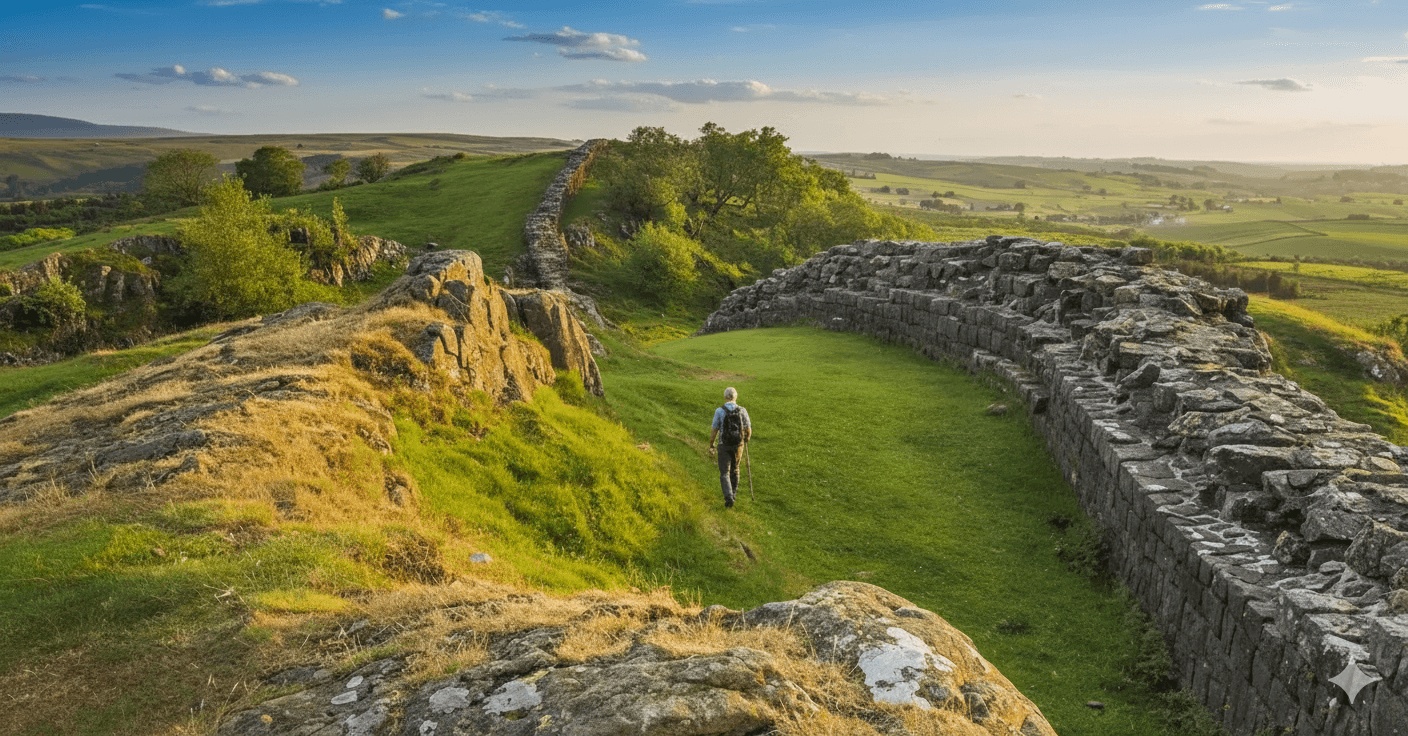
Straddling the border between Northumberland and Cumbria, the village of Gilsland and the nearby Birdoswald area represent a significant waypoint for walkers on Hadrian's Wall Path. Here the dramatic central crags begin to moderate, the terrain becomes gentler, and the character of the Wall starts its transition toward the western reaches. For those walking from east to west, Gilsland marks the approach to journey's final stages; for westbound walkers looking back, it's where the spectacular central section truly begins. Either way, the area deserves attention for both its Roman remains and its practical utility as a walking base.
The Gilsland and Birdoswald area offers some of the finest visible stretches of Hadrian's Wall, excellent Roman sites, comfortable accommodation options, and connections onward in both directions. Whether you're staying overnight or simply passing through, understanding what the area offers helps you make the most of this important section of your walking holiday.
The Popping Stone and Willowford
Just east of Gilsland, the path passes the Popping Stone, a large boulder beside the River Irthing where, according to Victorian tradition, the poet Walter Scott proposed to Charlotte Carpenter in 1797. The couple had met in Gilsland, which was then a fashionable spa resort, and the stone became a minor romantic pilgrimage site. Whether or not the story is entirely accurate, it speaks to Gilsland's 19th-century reputation as a place of fashionable retreat.
More significant for Roman enthusiasts is nearby Willowford, where the Wall crossed the River Irthing. The bridge abutments and associated remains here show Roman engineering at work, adapting their standard frontier to accommodate a significant river crossing. The east abutment preserves particularly well, showing how the Romans built foundations to withstand the river's force.
The stretch of Wall between Willowford and Birdoswald includes some of the longest continuous sections of standing Wall anywhere on the frontier. Walking alongside these ancient stones—still standing after nearly two millennia—creates an immediate connection to the past that excavated foundations cannot match. This is the Wall as it was meant to be experienced, a genuine barrier rather than an archaeological puzzle.
Birdoswald Roman Fort
Birdoswald (Roman Banna) is the major archaeological site in this area and merits its own extended visit. Managed by English Heritage, the fort combines substantial visible remains with excellent interpretive facilities. The turf-capped walls enclose one of the most evocative spaces on the Wall, where imagination easily reconstructs Roman military life.
The fort's position is dramatic, perched on a promontory overlooking the Irthing gorge to the south. The natural defences on this side allowed the Romans to concentrate their artificial fortifications on the more vulnerable northern and eastern approaches. From the fort, views extend in all directions—perfect for the watchful garrison tasked with guarding this section of the frontier.
The visitor centre at Birdoswald houses exhibitions explaining the site and provides café facilities welcome to tired walkers. Toilets are available. The site makes an ideal lunch or refreshment stop for those walking through, or a worthwhile half-day destination for those with more time.
Gilsland Village
Gilsland itself is a small village that grew up around the Victorian spa trade and later adapted to serve travellers on the Newcastle-Carlisle railway. The spa has long since closed, but the village retains a quiet charm and continues to offer hospitality to those passing through.
The most notable establishment is the Samson Inn, a traditional pub that has welcomed travellers for centuries. The pub serves food and maintains a selection of ales—exactly what walking holidays demand. On cool evenings, the warmth and conviviality of a proper pub provides the perfect end to a day on the trail.
Accommodation in Gilsland includes B&Bs and guest houses catering to Wall walkers. The scale is intimate—this isn't a tourist town—but what's available is typically comfortable and walker-friendly. Booking ahead is advisable during peak season, as the limited capacity fills quickly.
The village has a railway station on the Newcastle-Carlisle line, making arrival and departure by train straightforward. For those needing to return to starting points or continue onward journeys, this rail connection is valuable.
The Walking Experience
The section of Hadrian's Wall Path through Gilsland and Birdoswald offers excellent walking without the challenging terrain of the central crags. The path surface is generally good, the gradients are moderate, and the constant presence of Wall remains keeps the historical interest high. For walkers who found the crags demanding, this section provides welcome relief while remaining thoroughly rewarding.
Approaching from the east (Steel Rigg or Once Brewed), you'll experience the transition from dramatic crags to gentler terrain. The Wall remains visible and impressive, but the constant climbing and descending moderates. Many walkers find this a welcome change after the exertions of the central section.
Approaching from the west (Carlisle or Banks), the Gilsland area offers a preview of the drama to come. The Wall becomes more prominent, the terrain more varied, and the sense of the frontier's ambition more palpable. By the time you reach Birdoswald, you're fully in classic Wall country.
Practical Considerations
The Gilsland and Birdoswald area typically forms a convenient stopping point on most Wall itineraries. On our 6-day walk, the section often runs from Once Brewed to Gilsland, covering approximately 9 miles of excellent walking. Longer itineraries may break this differently, potentially spending more time in the area.
Facilities are adequate but limited. The Samson Inn provides the main eating option in Gilsland itself; Birdoswald's café offers alternatives during visitor season. For supplies, you'll need to have arrived prepared or rely on accommodation to provide packed lunches. This isn't a place for last-minute shopping.
Mobile phone coverage is variable. You'll usually get signal in Gilsland village but may find gaps along more remote sections of the path. If you need to make calls or send messages, plan to do so from settled areas.
Weather on this section can be mixed. The Irthing valley creates its own microclimate, sometimes holding mist when the heights above are clear. Rain is possible at any time of year. Carry waterproof layers as always, but expect gentler conditions than on the exposed crags further east.
Making the Most of Your Visit
For those overnight in the area, consider an evening stroll to absorb the landscape without the pressure of moving on. The stretch of Wall east from Birdoswald is particularly fine for relaxed exploration, with the possibility of watching sunset from the Roman stones if timing permits.
If you can spare half a day away from walking, Birdoswald merits extended exploration. The fort's extent becomes apparent only when you take time to walk the perimeter walls, explore the interior, and read the interpretive materials. The café provides a comfortable base for rest and reflection.
The combination of Gilsland's Victorian spa history, the Roman remains at Birdoswald and Willowford, and the natural beauty of the Irthing gorge creates a richly layered landscape. Each era has left its mark, and taking time to appreciate these layers adds depth to your experience of the Wall.
To discuss accommodation and itinerary options for the Gilsland and Birdoswald area, contact us. We know this section well and can help ensure your walking holiday includes comfortable stays in this important but sometimes overlooked portion of Hadrian's Wall.