Your Trip Tracker app, with an audio guide to the Wall
Every holiday comes with our trip app for your phone: each day's route on a map that works with no signal, your progress as you walk, all your bookings in one place, and short spoken stories about the places you pass.
Hear it for yourself
This is the track the app offers when you reach Housesteads Roman Fort (Vercovicium). It is exactly what you would hear on the day.
Read the words
Housesteads is the most complete Roman fort in Britain, and one of the best known anywhere in the Roman Empire. The Romans called it Vercovicium, the place of the effective fighters. It was built within ten years of AD 122, when work on the Wall began. Notice that the Wall came first. Its broad foundation and a turret were already here, and that turret now lies inside the fort. The fort covers about two hectares, and it was designed for an infantry regiment of eight hundred men. From the late second century to the fourth, the garrison was the First Cohort of Tungrians, first recruited in the district of Tongres, in modern Belgium. In the early third century they were joined by units raised in Frisia, now in the north-east of the Netherlands. Almost the whole line of the fort wall is exposed, with four gates. The west gate is one of the best preserved on Hadrian's Wall. Inside, on a regular grid, are the headquarters, the commanding officer's house, the granaries, and a large courtyard building that was probably a hospital. Find the south-west corner for the communal latrines, one of the most remarkable survivals of Roman Britain. Outside the south gate, the remains of houses from the civilian settlement line the road. Roman rule in northern Britain ended around the turn of the fifth century, but that wasn't the end of the place. By the south gate is a late medieval defended farmhouse, called a bastle. By the end of the sixteenth century Housesteads was notorious as a haunt of rustlers and thieves, and the antiquary William Camden stayed away for fear of the robbers. In the nineteenth century the fort became the highlight of John Clayton's Roman Wall estate. From a thieves' haunt to the highlight of an estate.
What it looks like on the trail
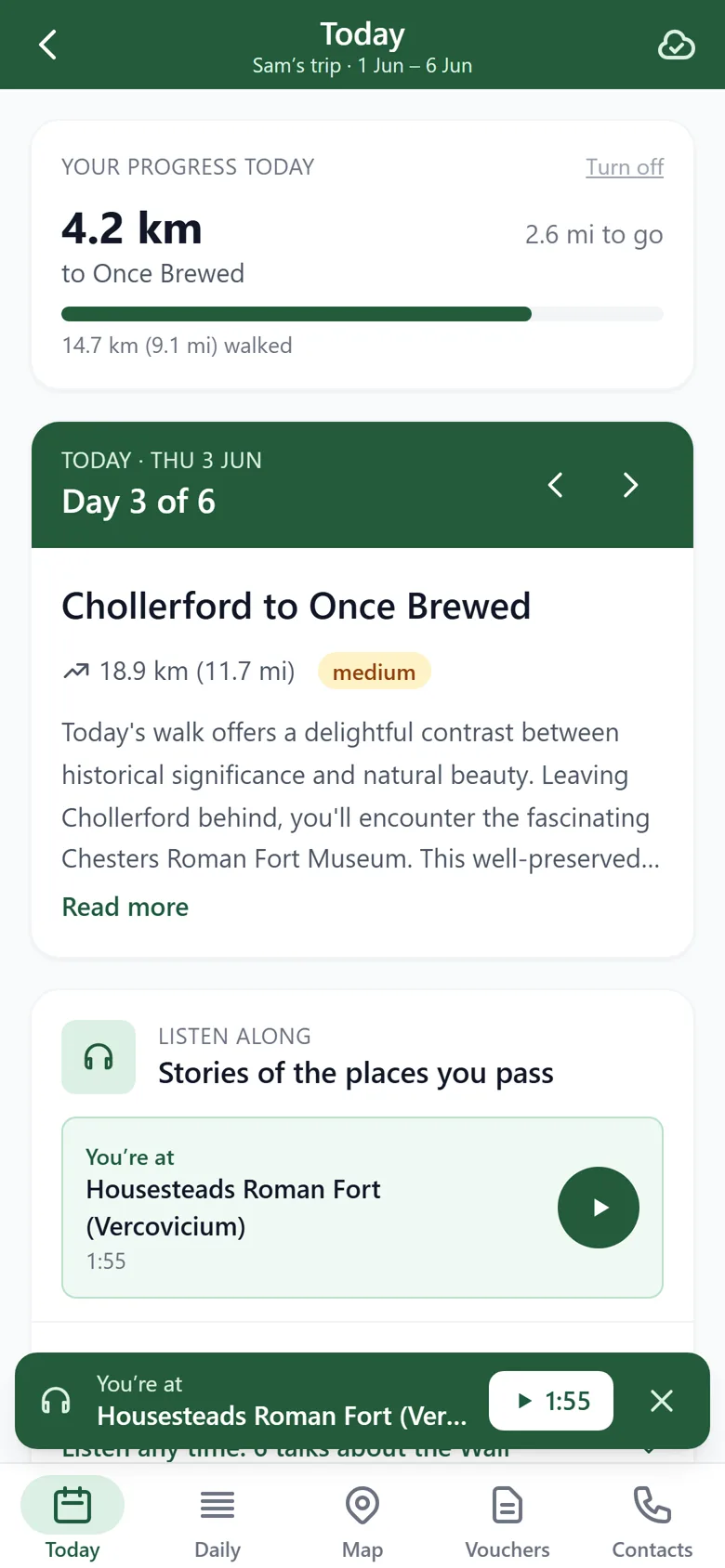
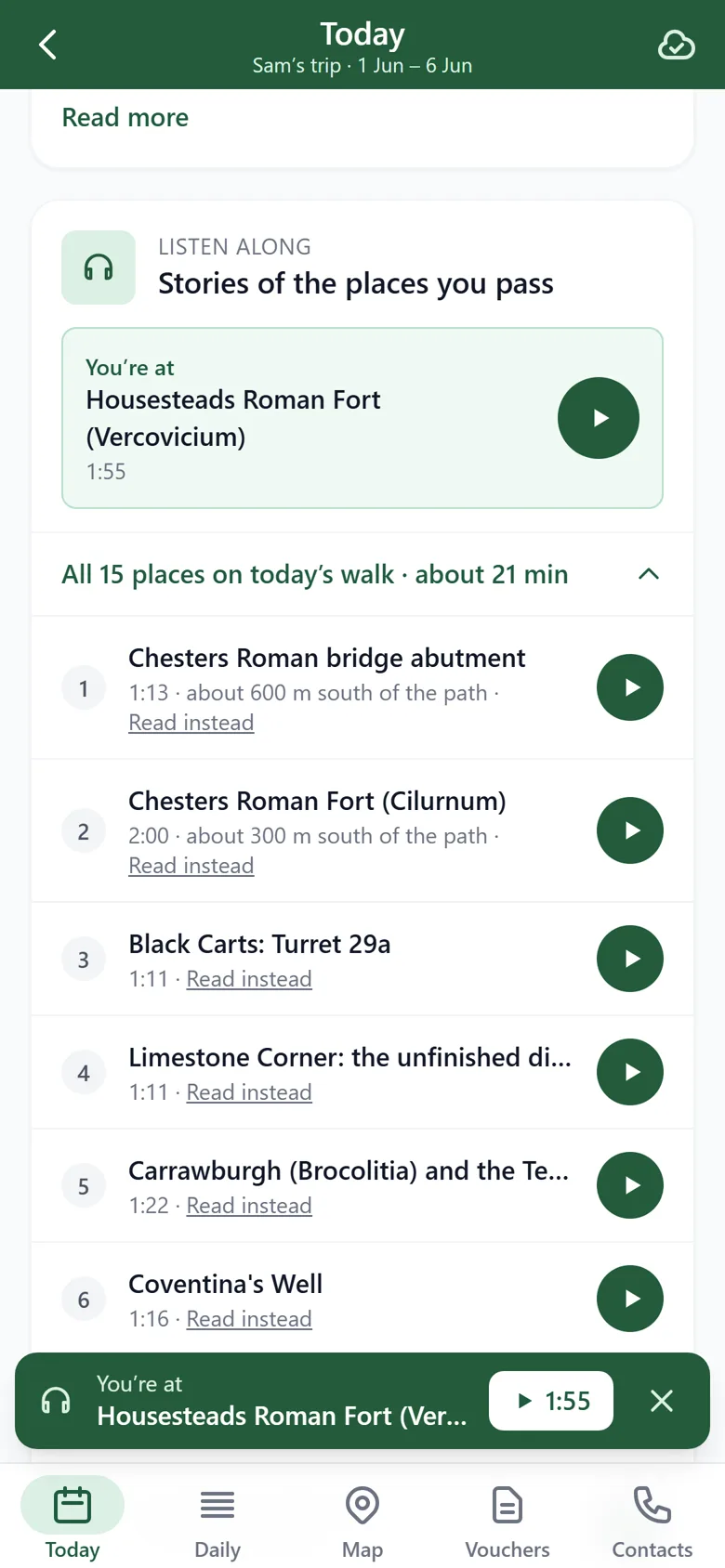
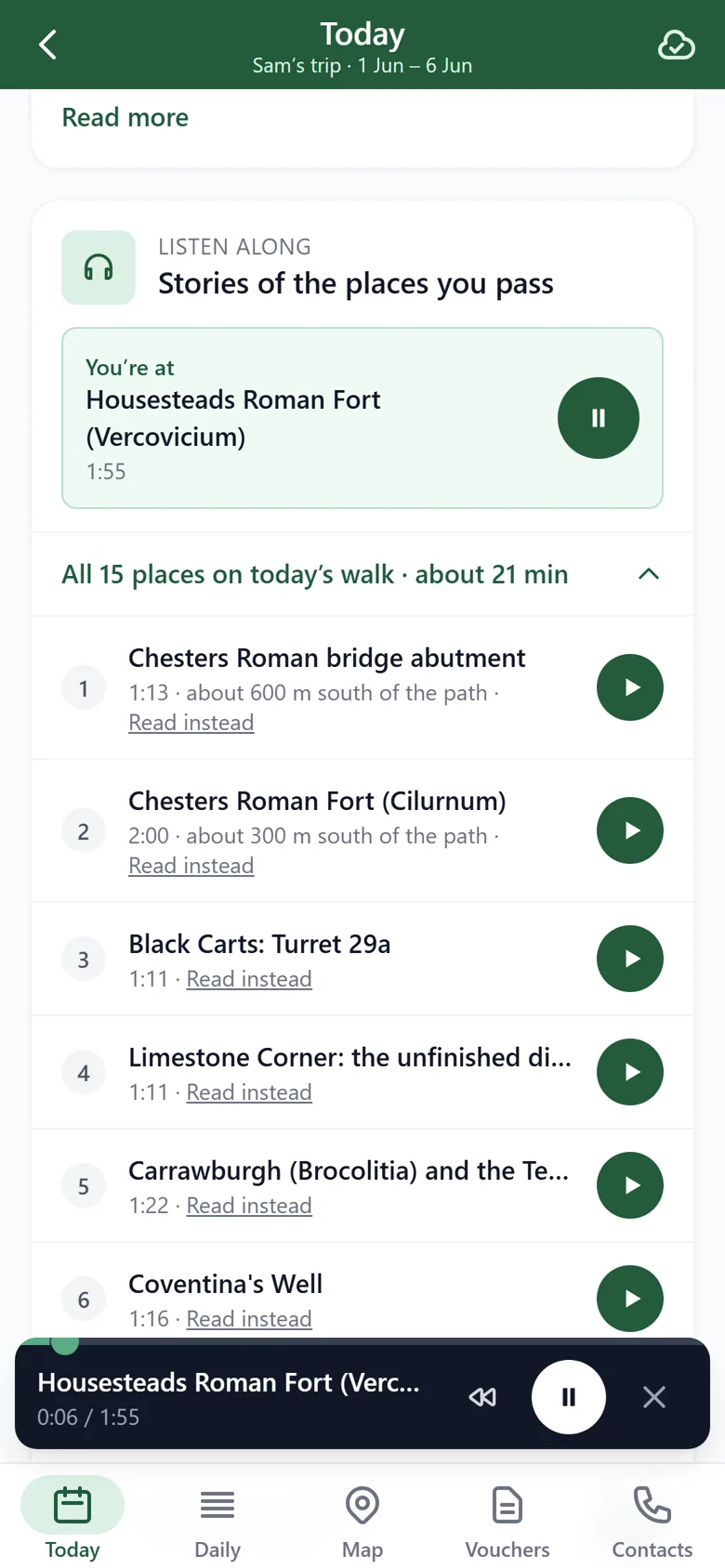
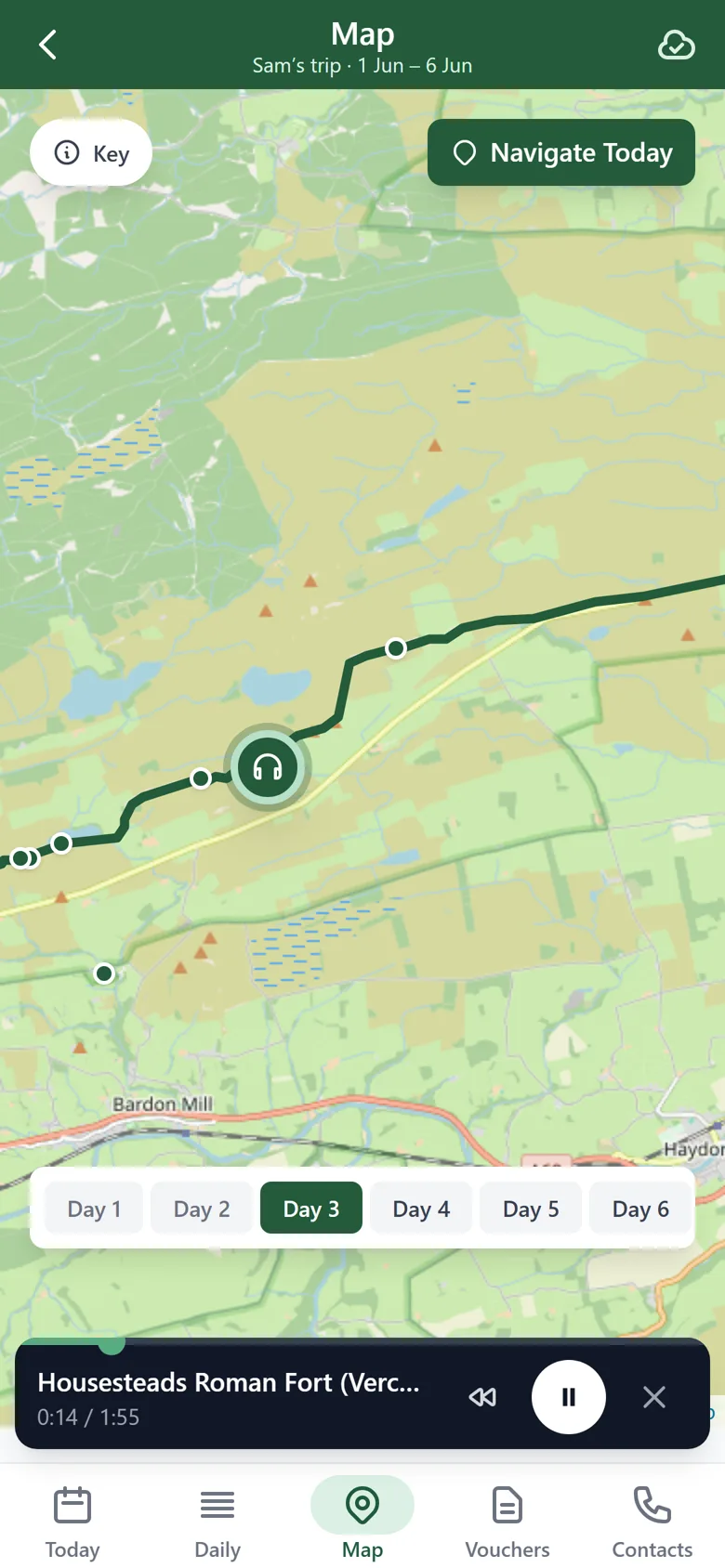
Screenshots from a sample trip. Map data © OpenStreetMap contributors.
What the app does
- Maps that work with no signal
- Each day's route on a map. Save it to your phone before you set off and it works on the open moors where there is no signal.
- Your progress as you walk
- Turn it on and the app uses your phone's GPS to show how far you have walked and how far is left to the end of the day.
- The way to tonight's bed
- Where your accommodation is a short walk from the day's finish, the app shows that walk; where we have booked you a transfer, it says so.
- Your whole trip in one place
- Day by day itinerary, accommodation addresses and phone numbers, vouchers and contacts.
The audio guide
- 55 places, 6 talks, about 85 minutes
- Short stories, mostly one to two minutes, for forts, turrets, milecastles, bridges and landmarks from Wallsend to Bowness-on-Solway, plus talks on why the Wall was built, who built it and who served on it.
- Offered as you arrive
- With progress turned on, the app shows “You're at Housesteads” when you reach a place. You tap play. Nothing starts by itself, and every track can be played at any time from the list, at breakfast or on the train home.
- Researched, sourced and checked
- Every fact in the scripts comes from a named source, such as English Heritage, the Vindolanda Trust, Roman Inscriptions of Britain, Northumberland National Park and the National Trail, and each script was checked a second time, line by line, against those sources.
- Read instead of listen
- Every track has its words on screen, for anyone who would rather read.
Getting it on your phone
- Open it from your booking. Once you have booked, open the app from your online booking account, or sign in with a link we email to you.
- Add it to your home screen. On an iPhone, tap Share in Safari, then Add to Home Screen. On Android, open Chrome's menu and choose Install app or Add to Home screen. It is a web app, so there is nothing to download from an app store.
- Tap Save before you set off. With signal, ideally on Wi-Fi, save the maps and audio guide to your phone (up to about 65 MB for a full crossing). After that it all works with no signal.
Worth knowing
- The narration is an AI voice with a calm North-East accent. The words were written and checked by us; the voice reading them is computer-generated.
- The app follows you only while it is open on your screen. It can't detect where you are with your phone locked in a pocket, so glance at it when you reach somewhere interesting.
- GPS uses battery. Progress is easy to switch off, and a small power bank in your daypack is a good idea on long days.
Ready to walk the Wall?
The app and audio guide come with every holiday.